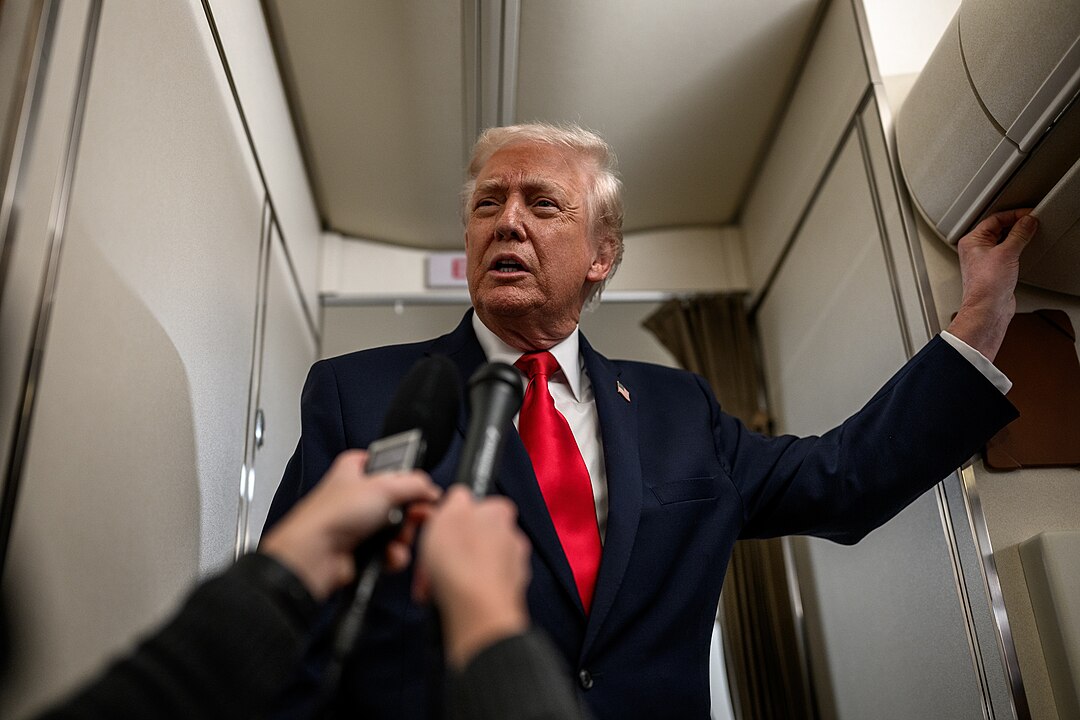
President Donald Trump answers questions from members of the media aboard Air Force One en route to Mount Pocono, Pennsylvania, for a rally on the economy, Tuesday, December 9, 2025. (Official White House Photo by Molly Riley)
President Donald Trump late Sunday said Cuba appears “ready to fall” following the dramatic U.S. operation that resulted in the capture of Venezuelan leader Nicolás Maduro and his wife, warning that Havana can no longer depend on Caracas for security, intelligence support, or subsidized oil.
Speaking to reporters aboard Air Force One, Trump argued that Maduro’s removal has exposed the fragile foundation of Cuba’s communist regime, which for years relied heavily on Venezuela’s oil wealth and political backing to stay afloat.
“I think it’s just going to fall,” Trump said when asked whether the United States was considering action against Cuba. “I don’t think we need any action. Looks like it’s going down. It’s going down for the count.”
President Trump now says that Cuba is "Ready to fall" and that a lot of Cuban-Americans are going be "very happy" about it.
That’s a MAJOR understatement.
Watching the communist regime fall in Cuba is a life long dream for Americans from Cuba.
Trump said Cuba’s fate is now directly tied to Maduro’s ouster and the collapse of Venezuela’s ability to bankroll socialist allies throughout the region. For more than two decades, Venezuela has provided Cuba with deeply discounted oil in exchange for intelligence, security forces, and political support — a lifeline that helped keep Cuba’s authoritarian system in place despite chronic economic failure.
The president’s remarks came one day after U.S. forces captured Maduro and his wife during what administration officials described as a bold counter-narco-terrorism operation. Maduro faces charges related to a long-running conspiracy involving drug trafficking and terrorism, allegations U.S. officials say were backed by years of intelligence gathering.
The operation sent shock waves through Latin America, particularly among left-leaning governments. Cuban officials responded by calling for mass rallies in support of Venezuela’s regime and accused the United States of violating national sovereignty. The Biden-era policy of accommodation toward Havana, Trump allies argue, emboldened Cuban intelligence services to expand their influence throughout the region.
U.S. officials have long maintained that Cuba played a decisive role in keeping Maduro in power. Secretary of State Marco Rubio said Cuban operatives effectively controlled Venezuela’s internal intelligence and security apparatus, ensuring Maduro’s survival even as his government lost popular support.
“It was Cubans that guarded Maduro,” Rubio said. “He was not guarded by Venezuelan bodyguards. He had Cuban bodyguards.”
Rubio added that Cuban intelligence officials closely monitored loyalty inside Maduro’s government, helping suppress dissent and maintain the regime through intimidation and surveillance.
On Sunday, Cuba’s government acknowledged that 32 Cuban military and police officers were killed during the American operation — the first official death toll released by Havana. Cuban state media said the personnel had been deployed at the request of Caracas and announced two days of national mourning.
Trump confirmed Cuban casualties while traveling back to Washington.
“A lot of Cubans were killed yesterday,” he said. “There was a lot of death on the other side. No death on our side.”
The president also used the opportunity to criticize neighboring Colombia, accusing its leadership of failing to curb drug trafficking operations that funnel narcotics into the United States. Trump has repeatedly argued that weak enforcement and leftist governance in parts of Latin America directly contribute to America’s fentanyl and drug crisis.
Administration officials say the capture of Maduro marks a turning point for the Western Hemisphere, signaling a renewed U.S. commitment to confronting authoritarian regimes, narco-states, and foreign intelligence networks operating near American borders.