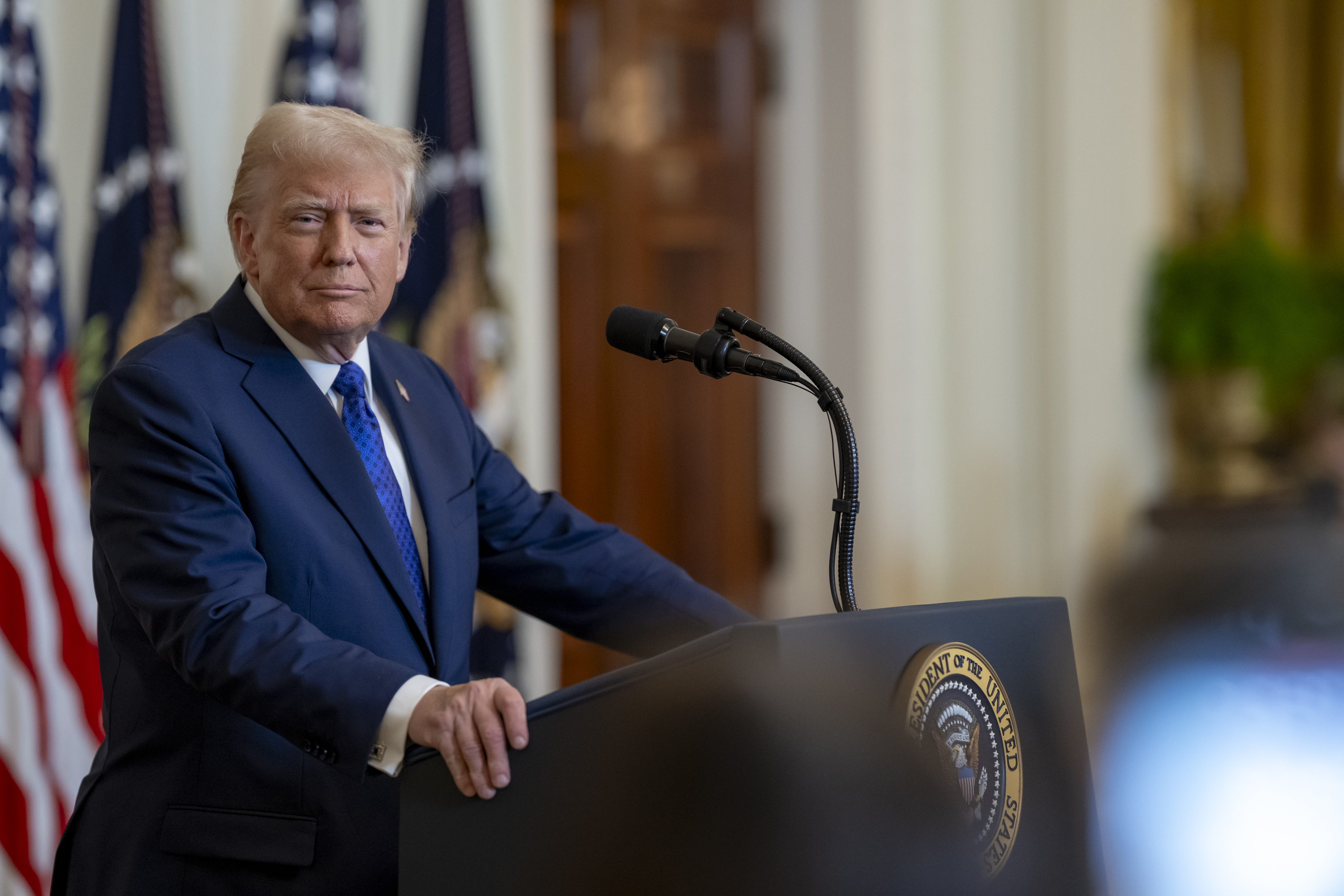
President Donald Trump said Monday that he has not decided whether he will personally attend the formal signing ceremony for the newly announced U.S.-Iran agreement later this week in Geneva, Switzerland.
Speaking to reporters after arriving in France for the Group of Seven (G7) summit, Trump indicated that Vice President JD Vance may represent the administration at Friday’s ceremony instead.
“It depends,” Trump said when asked whether he would attend the signing. “JD’s coming in for it. He was originally going to do it. I’ll probably be gone by then.”
The president, seated alongside French President Emmanuel Macron, said scheduling conflicts tied to the G7 summit could keep him from traveling to Switzerland.
“I may be involved, I may not,” Trump added.
Trump nevertheless praised the agreement, describing it as a “very powerful document” and claiming it will prove more successful than the Obama-era Joint Comprehensive Plan of Action (JCPOA), the 2015 nuclear agreement from which he withdrew during his first term.
The comments come as the administration continues to withhold key details of the accord, which aims to end more than three months of conflict between the United States and Iran and reopen the strategically vital Strait of Hormuz.
Deal Already Signed Digitally
Although the formal ceremony is scheduled for Friday, U.S. officials say the framework agreement has already been signed electronically.
Vice President Vance confirmed that Trump, Vance, and Iranian Parliament Speaker Mohammad Bagher Qalibaf digitally signed a memorandum of understanding on Sunday, establishing the basis for the broader agreement. Formal signatures are expected during the Geneva ceremony later this week.
Vance and Trump’s son-in-law, Jared Kushner, are expected to attend the signing event. Vance previously said it remains possible that Trump could ultimately decide to participate in person if logistics allow.
What We Know About the Agreement
While the full text has not yet been released, administration officials and diplomatic sources have outlined several major provisions.
The agreement establishes a 60-day negotiation period focused on Iran’s nuclear program and broader regional security issues. It also calls for reopening the Strait of Hormuz, a critical waterway through which roughly 20 percent of the world’s oil exports pass.
The closure of the strait during the conflict disrupted global energy markets and contributed to rising fuel prices worldwide.
Trump said Monday that restoring shipping traffic through the strait would benefit both the global economy and regional stability.
“Hopefully it’s going to be a good relationship and we’re going to get along,” he said. “And if we don’t, we go back to where we started.”
The deal is also expected to include phased sanctions relief and the release of frozen Iranian assets, contingent upon Tehran meeting future obligations related to its nuclear program. Administration officials have emphasized that any economic benefits would be tied to Iranian compliance.
Details Still Under Wraps
Despite growing international attention, many aspects of the agreement remain unclear.
Trump said additional information would likely be released sometime after Friday’s signing ceremony. However, senior administration officials had previously suggested that details could become public sooner.
Questions also remain about enforcement mechanisms, the future of Iran’s enriched uranium stockpile, and how compliance will be verified. Some reports indicate negotiators are still working through technical issues even as preparations for the signing ceremony move forward.
Israel Signals Concerns
The agreement has already drawn criticism from some Israeli officials.
According to U.S. officials familiar with the negotiations, the deal does not require Israel to withdraw forces from Lebanon. Israeli leaders have continued to insist they will maintain military operations against Iran-backed Hezbollah militants regardless of the U.S.-Iran accord.
Israeli National Security Minister Itamar Ben-Gvir has publicly stated that Israel is not “subject to the United States” on security matters, highlighting potential tensions as the agreement moves toward implementation.
Looking Ahead
For now, the administration is portraying the agreement as a major diplomatic breakthrough that could stabilize global energy markets and create a pathway toward addressing Iran’s nuclear ambitions.
Whether Trump ultimately travels to Geneva for the signing remains uncertain. But the president made clear Monday that he views the agreement as a signature foreign policy achievement.
The formal ceremony is expected to take place this Friday in Switzerland.