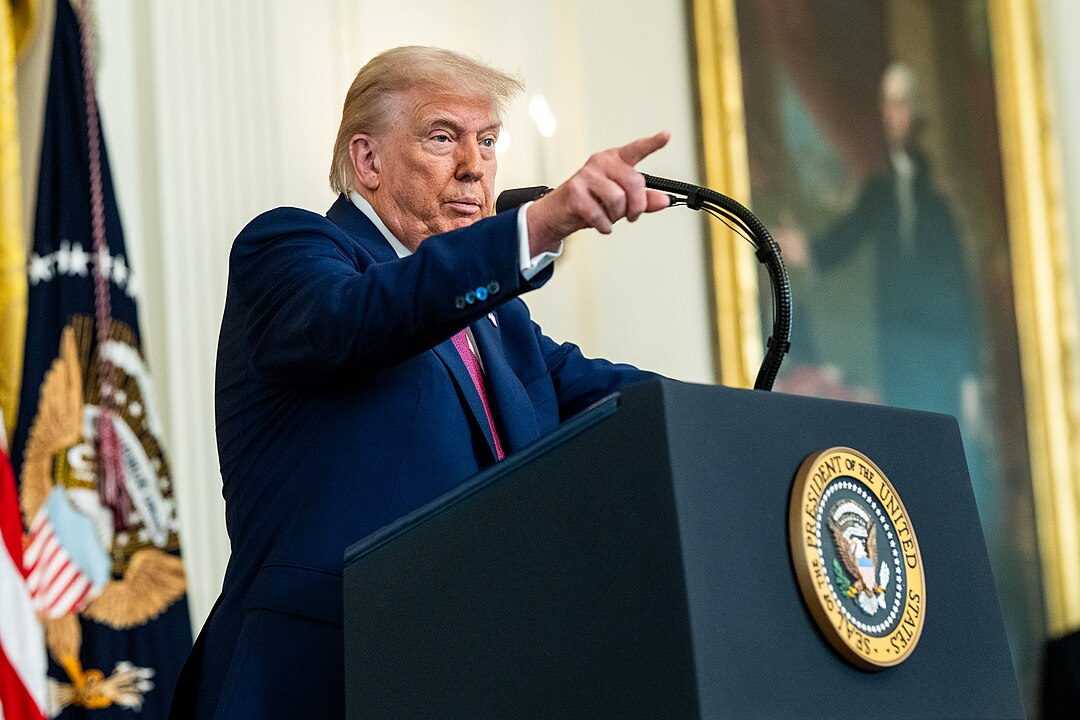
President Donald Trump on Monday intensified his long-running campaign against fentanyl, signing an executive order that formally designates the deadly synthetic opioid as a “weapon of mass destruction.” The move significantly expands the federal government’s ability to confront countries, cartels, and transnational organizations tied to the drug’s production and trafficking.
Trump signed the order during an Oval Office ceremony honoring U.S. military personnel with the Mexican Border Defense Medal, recognizing service members who were deployed to reinforce security along the southern border. The president used the moment to underscore the severity of the fentanyl crisis, warning Americans about the devastation the drug continues to inflict.
“No bomb does what this is doing,” Trump said, attributing 200,000 to 300,000 deaths per year to fentanyl and its analogues. He described the synthetic opioid as a “scourge” that has penetrated communities nationwide, often through supply chains that begin in China and flow through Mexico before reaching U.S. streets.
Why This Executive Order Matters
By designating fentanyl as a WMD, the Trump administration unlocks additional legal and national-security mechanisms typically reserved for chemical, biological, or radiological threats. These authorities allow the federal government to:
- Increase pressure on foreign governments—particularly China and Mexico—believed to be central nodes in fentanyl production.
- Target cartels and affiliated networks with enhanced sanctions and intelligence operations.
- Coordinate across national-security, defense, and law-enforcement agencies more aggressively than before.
For many conservatives, the move represents a long-overdue acknowledgment of fentanyl’s toll and a shift toward treating the crisis as the national-security threat it has become.
Part of Trump’s Broader Anti-Fentanyl Agenda
The executive order follows several earlier actions by Trump aimed at cutting off fentanyl at its source:
- Tariffs on China, Canada, and Mexico: Trump has repeatedly argued these nations must take responsibility for the flow of precursor chemicals and finished fentanyl into the U.S.
- Designation of major cartels as Foreign Terrorist Organizations, enabling harsher penalties and expanded international cooperation.
- Signing the HALT Fentanyl Act, which tightened criminal penalties, accelerated scheduling of new fentanyl analogues, and strengthened law enforcement’s ability to crack down on traffickers.
Trump has long framed the fentanyl epidemic not merely as a public-health crisis but as a matter of border security, national security, and foreign policy discipline—a position that resonates strongly with many Republican voters.
As the fentanyl crisis continues to devastate families across the country, the latest executive order signals the administration’s willingness to elevate the fight to a new level, using the full weight of federal power to confront the networks responsible.