A federal judge handed President Donald Trump a legal victory Monday by dismissing a lawsuit that accused his Religious Liberty Commission of improperly excluding certain faiths and viewpoints.
U.S. District Judge John P. Cronan, a Trump appointee serving in New York, rejected a multifaith coalition’s argument that the commission violated the Federal Advisory Committee Act’s requirement that presidential advisory panels be “fairly balanced.”
“Under this deferential standard, the RLC’s membership is fairly balanced,” Cronan wrote in his 49-page ruling.
The judge noted that the commission includes people from the public, private and nonprofit sectors with a wide range of backgrounds. Its members include religious leaders and rank-and-file congregants who, Cronan wrote, “encompass adherents of at least five different religions.”
The lawsuit was filed by Interfaith Alliance, Muslims for Progressive Values, the Sikh American Legal Defense and Education Fund, Hindus for Human Rights and the Rev. Paul Brandeis Raushenbush, president and CEO of Interfaith Alliance.
The plaintiffs argued that the commission overwhelmingly represented Christian and Jewish perspectives while excluding Muslims, Hindus, Sikhs, Buddhists and nonreligious Americans.
Cronan rejected the notion that the commission’s composition amounted to an unlawful imbalance, emphasizing the range of beliefs within Christianity and Judaism.
“Given the wide diversity of Christian and Jewish beliefs, there is no reason to think that an Evangelical member would ‘balance out’ a Catholic member any less than a Buddhist member would,” Cronan wrote.
The judge added that a 14-member panel could not realistically represent every religious denomination in the country.
“If an unavoidable reality of a fourteen-member commission is that some groups will be left out, Plaintiffs do not justify why leaving out non-‘Judeo Christian’ religions is any more imbalanced than leaving out religions within that group,” he wrote.
Cronan said the law requires the commission to be “fairly” balanced—not perfectly balanced. He also noted that Ismail Royer, a Muslim religious-liberty advocate, serves on one of the commission’s advisory boards.
Trump established the Religious Liberty Commission through an executive order in May 2025 as part of his administration’s effort to combat what he described as growing threats to Americans’ freedom of worship.
The order tasked the commission with examining the foundations of religious liberty in the United States, identifying current threats and recommending executive or legislative actions to strengthen religious protections.
The commission is chaired by Texas Lt. Gov. Dan Patrick and vice-chaired by former Housing and Urban Development Secretary Ben Carson. Its members have included Cardinal Timothy Dolan, the Rev. Franklin Graham, Bishop Robert Barron, Pastor Paula White, television personality Dr. Phil McGraw and Orthodox Rabbi Meir Soloveichik.
In June, the commission presented Trump with a draft report based on seven hearings and testimony from more than 100 witnesses, according to the Justice Department.
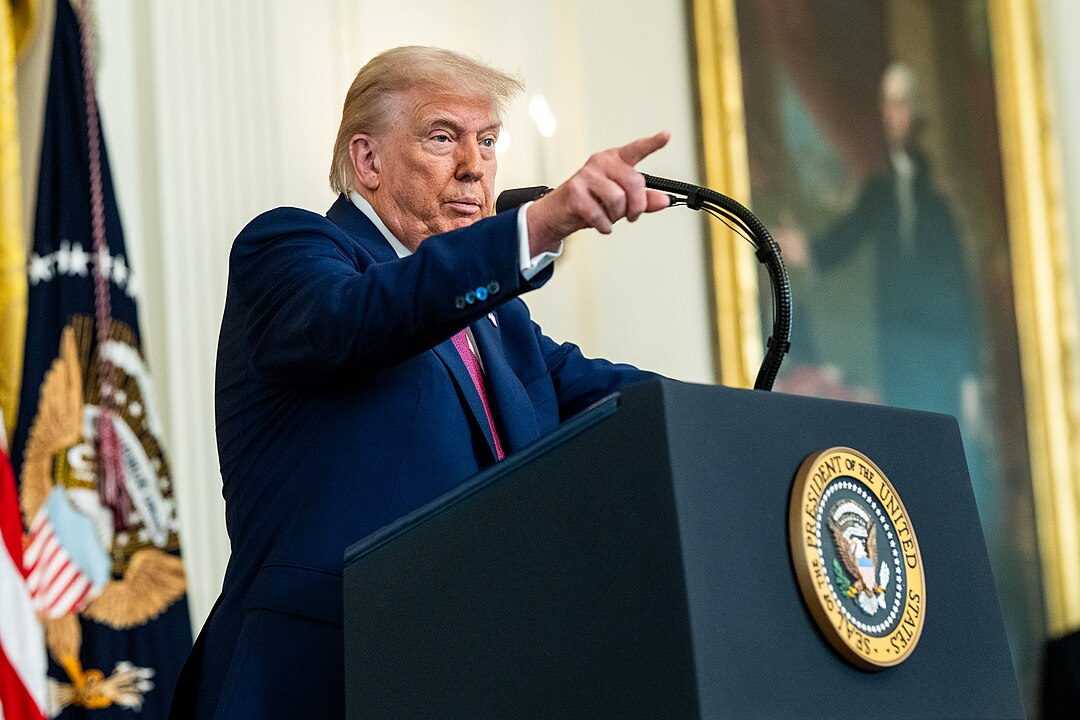
“We’re bringing back religion in our country, and we’re bringing it back quickly and strongly—because for America to be a great nation, we must always be one nation under God,” Trump said during the report’s presentation.
The report’s recommendations include repealing the Johnson Amendment, creating a Justice Department religious-liberty task force, establishing reporting portals for alleged violations and issuing new federal guidance on the Establishment Clause and the separation of church and state.
The coalition also accused the commission of failing to release meeting records and other materials required under federal law. The administration subsequently published transcripts, minutes, witness statements, agendas and video recordings while the litigation was pending.
Cronan ruled that the plaintiffs’ original disclosure allegations were no longer accurate after those materials became publicly available. He dismissed the organizational plaintiffs’ claims with prejudice for failing to state a valid claim. Raushenbush’s individual claims were dismissed without prejudice after the judge determined that he lacked standing.
In a statement following the ruling, the coalition claimed the lawsuit had still achieved greater transparency.
“Religious liberty and pluralism are foundational American values, and we remain committed to fighting for a democracy that does not promote a single religious belief and ignores others,” the coalition said.