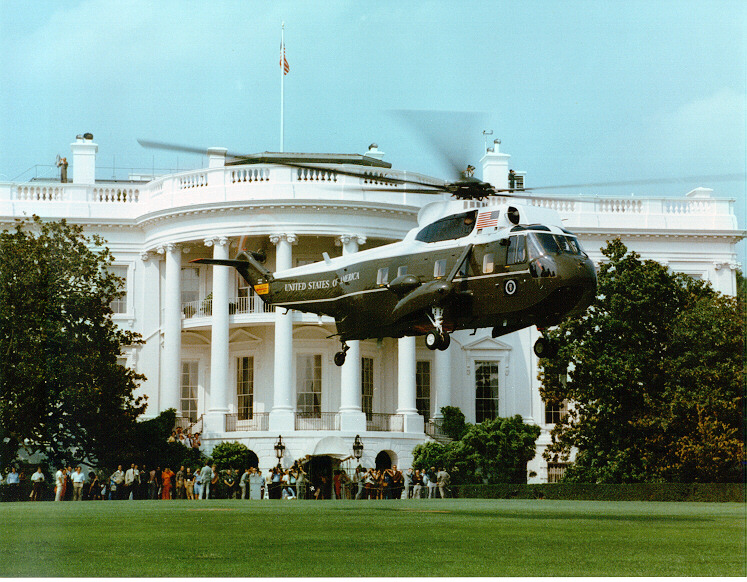
President Donald Trump announced Sunday that the newly rebuilt White House helipad is officially complete, unveiling the latest addition to the executive mansion’s grounds.
Trump celebrated the finished project by sharing a historic photograph of former President Dwight D. Eisenhower preparing to board an Air Force helicopter outside the White House in 1957.
“Dwight Eisenhower didn’t need a Helipad at the White House for those little Choppers, but America needs one now — Just completed, and MAGNIFICENT!” Trump wrote on Truth Social.
The completed landing area is designed to accommodate the presidential helicopter fleet and features granite construction and a large presidential seal.
Trump Touts Safety And Appearance
Trump initially announced that the helipad was ready during an Oval Office appearance on Sept. 2, describing it as safer and more attractive than the grass landing area previously used by presidential helicopters.
Helicopters had landed directly on the South Lawn “for many years,” Trump told reporters, according to NOTUS.
“It’s not good and very unsafe,” Trump said.
The president praised the completed pad as “more beautiful than I would have thought.”
“Incredible the job they’ve done,” he added. “Carved granite with the seal of the president of the United States.”
The project is approximately 100 feet wide and constructed from granite slabs roughly four inches thick. Trump has said the new surface can accommodate helicopters of virtually any size.
The landing zone will be used by aircraft operating under the Marine One call sign whenever the president is aboard. Trump has also suggested it could serve other purposes, including welcoming foreign leaders, hosting news conferences and providing additional space for events connected to the new White House ballroom.
New Helicopters Raised Concerns About The Lawn
One reason for the project was the effect newer presidential helicopters could have on the South Lawn.
The Sikorsky VH-92A Patriot was introduced to replace aging aircraft in the presidential fleet, but concerns about its exhaust damaging landing surfaces complicated its use at the White House.
The Government Accountability Office documented the issue after testing showed that the helicopter’s exhaust could damage a landing zone. Older helicopters consequently continued handling arrivals and departures from the South Lawn while the newer aircraft were used elsewhere.
Trump said in July that helicopters had burned and torn up sections of the grass.
“So, now we’re building a helipad, a beautiful helipad, and it’s got the seal of the White House on it, in granite, in carved granite,” he said at the time, according to ABC News.
Who Paid For The Project?
Trump initially estimated that the helipad would cost between $5 million and $6 million and said Sikorsky Aircraft, a subsidiary of Lockheed Martin, would cover the full expense.
A Lockheed Martin spokesperson subsequently told ABC News that the company made a contribution to the National Park Service, adding that its work with the federal government followed applicable ethics and compliance rules.
During an Aug. 19 tour of the construction site, Trump said Sikorsky was paying much of the cost, with additional donations coming from several people, including himself.
Trump also signed one of the granite sections during the tour. He said the signature would be placed on the back of the eagle forming part of the presidential seal, leaving it hidden after installation.
“This is a helipad at the highest level,” Trump told reporters. “It can land any helicopter in the world, no matter how big, no matter how powerful, no matter how strong.”
Design Changes Delayed The Work
The project underwent revisions after Trump requested changes to its height and alignment with the sloping South Lawn.
Trump later acknowledged that his request to raise and level the landing area added approximately a week and a half to the construction schedule.
The president publicly toured the site while crews were still working, saying the finished project would look “incredible from the air and from every place else.”
Its completion comes ahead of a planned visit by Chinese President Xi Jinping later this month.
Trump connected the new construction to the history of presidential aviation by highlighting Eisenhower’s first helicopter flight. According to the Smithsonian’s National Air and Space Museum, Eisenhower became the first sitting president to fly in a helicopter on July 12, 1957, during a civil defense exercise testing how quickly national leaders could evacuate Washington.
Nearly seven decades later, the White House now has a permanent granite landing pad built for a much larger and more advanced presidential fleet.