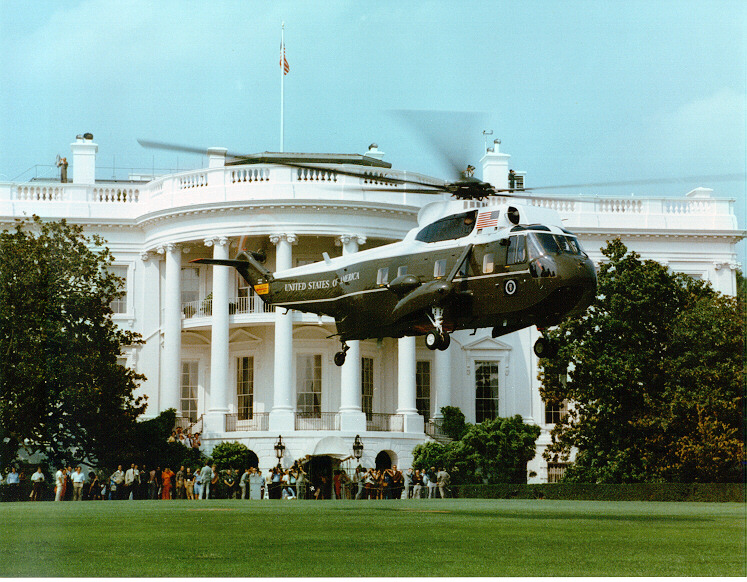
President Donald Trump has ordered contractors to redo portions of the new White House helipad after deciding that the project taking shape on the South Lawn did not look right, according to a new report.
The Washington Post reported Tuesday that crews have begun dismantling weeks of work, including portions of a roughly 100-foot-wide granite presidential seal that had started to emerge at the center of the landing pad.
Trump reportedly objected to the angle of the project and questioned whether the surrounding lawn should be regraded so the finished helipad appears level with the horizon.
The South Lawn slopes downward, and contractors are now considering whether changes to the terrain will be necessary before rebuilding the pad, according to two people familiar with the president’s private comments who spoke to the Post on the condition of anonymity.
The revisions come after construction crews had been working around the clock to meet an accelerated September deadline.
Trump reportedly wants the work completed ahead of Chinese President Xi Jinping’s anticipated state visit, which is expected on Sept. 24. Contractor records previously obtained by the Post showed that the original schedule had been shortened by more than a month, with completion ordered by Sept. 17.
It remains unclear how much additional time or money the redesign will require.
Lockheed Martin, the parent company of helicopter manufacturer Sikorsky, is funding more than $5 million of the helipad work through a donation. The Post previously reported that a broader $13 million package also includes upgrades to the nearby South Portico and an adjacent section of the White House driveway.
Clark Construction, which is carrying out the project, referred questions about the redesign to the White House. Lockheed Martin did not immediately say whether it would cover any added costs.
The White House defended the project while declining to address Trump’s requested changes directly.
“For years, the White House has desperately needed a proper Helipad on White House grounds that will allow the President to land safely and also protect the beautiful South Lawn grass from the fierce exhaust fumes of the incredible Marine One,” White House spokesman Davis Ingle said in a statement.
“Thanks to President Trump, the White House has never looked better, and it will only continue to get better under his leadership.”
The permanent landing pad is intended to solve a problem that predates Trump’s current term.
The newer VH-92A Patriot helicopters built by Sikorsky have downward-facing exhaust vents that can scorch the White House lawn. A 2019 Government Accountability Office report identified landing-zone damage as one of the aircraft program’s unresolved performance challenges.
Naval Air Systems Command accepted the 23rd and final VH-92A in August 2024, completing a fleet composed of 21 operational helicopters and two test aircraft. The aircraft were designed to deliver greater performance, payload capacity and communications capabilities than the aging VH-3D and VH-60N helicopters they are replacing.
Trump publicly confirmed the helipad project in July, saying the newer aircraft are far more powerful than their predecessors and can rip up the grass during landings.
“Let’s do a beauty. Let’s not just do a piece of concrete and paint it white,” Trump said at the time, describing plans for a carved granite seal.
He also suggested the completed pad could double as a space for news conferences and other White House events when Marine One is not using it.
Federal Aviation Administration guidance recommends that ground-level helicopter landing areas retain a slight gradient for drainage. For transport heliports, the agency recommends a longitudinal gradient of between 0.5 percent and 1 percent and a transverse gradient of between 0.5 percent and 1.5 percent.
Marine One has temporarily been landing on the Ellipse, just south of the White House, while work continues on the South Lawn.
The helipad is one of several changes Trump has directed across the White House complex during his second term. But unlike some of the president’s more decorative renovations, current and former officials have described the landing pad as an operational upgrade that earlier administrations also considered but did not pursue.
If completed as planned, the new helipad would protect the historic grounds while allowing the latest generation of presidential helicopters to operate regularly from the White House.