President Donald Trump’s new director of national intelligence, Jay Clayton, was sworn in Monday, ending an unusual transition that kept controversial acting intelligence chief Bill Pulte in charge for nearly a week after Clayton’s Senate confirmation.
The Senate confirmed Clayton last Tuesday in a 51-47 party-line vote, with Republicans supporting the nomination and Democrats opposing it. A confirmed nominee would ordinarily assume control shortly after Senate approval, but Clayton’s swearing-in was delayed while Pulte remained at the Office of the Director of National Intelligence.
Clayton formally took charge Monday and pledged to restore public confidence in the nation’s intelligence agencies through stronger oversight and accountability.
“Throughout my career, I have been charged with building world-class teams committed to their mission, and we have delivered for the people we serve,” Clayton said in a statement announcing the transition.
“The safety and security of the American people will be our North Star, and we will work to make sure the American people have complete confidence in the IC through proper oversight, transparency, and accountability,” he continued. “This includes ensuring the vital work of our IC is never weaponized for political motives.”
Clayton said he intends to build an intelligence community that is “streamlined, agile, team-oriented, and mission-focused” while ensuring its employees have the resources needed to protect the country.
The director of national intelligence oversees and coordinates the agencies that make up the U.S. intelligence community and serves as the president’s principal intelligence adviser.
Trump Gives Clayton Broad Authority
Speaking with reporters Sunday, Trump said he had given Clayton a straightforward directive.
“Just do a great job,” Trump said, according to the New York Post.
Asked whether he wanted Clayton to continue the work Pulte began at ODNI, Trump added, “I want him to do what he wants to do. He’s outstanding.”
Clayton previously served as chairman of the Securities and Exchange Commission during Trump’s first term and, most recently, as U.S. attorney for the Southern District of New York. His office handled cases involving terrorism, espionage, financial crimes and public corruption.
The White House promoted Clayton’s executive experience and work on national security cases when Trump announced his selection. Republican lawmakers argued that his background managing complex investigations and large organizations prepared him to oversee the intelligence community. The White House described him as a proven leader capable of strengthening and reforming the country’s intelligence operations.
Clayton’s confirmation hearing was more contentious than initially expected, however. Democrats criticized him for refusing to state directly that Joe Biden defeated Trump in the 2020 election, instead saying the election had been certified for Biden. Those exchanges ultimately cost Clayton the bipartisan support some Republicans had anticipated.
Pulte Steps Aside
Pulte announced over the weekend that he would relinquish control Monday following discussions with Trump and Clayton.
“After speaking with President Trump and Jay Clayton, we have decided the DNI transition will take place this coming Monday,” Pulte wrote on X. “I am eternally grateful to President Trump for the opportunity to serve as Director of National Intelligence, while he completed historic declassifications and we right sized the ODNI.”
Pulte also offered Clayton his “complete and total support” during the transition.
Pulte simultaneously led the Federal Housing Finance Agency, where he forwarded criminal referrals involving mortgage-fraud allegations against several prominent Trump opponents. His temporary appointment to ODNI drew criticism from senators in both parties over his lack of intelligence experience and the Trump administration’s decision to keep him in place after Clayton was confirmed.
“It’s a terrible idea. His successor has been confirmed. There’s no earthly reason he should stay there another five minutes,” Sen. Angus King, I-Maine, told The Hill last week.
During his brief tenure, Pulte oversaw several rounds of personnel cuts. He said the changes reduced ODNI staffing by roughly 30 percent through layoffs and the return of employees who had been detailed from other agencies. He also declassified intelligence related to alleged Chinese interference in the 2020 election.
Clayton succeeds Tulsi Gabbard, Trump’s first Senate-confirmed intelligence director of his second term. Gabbard left the administration earlier this summer to care for her husband during his cancer treatment.
A Busy Monday For Trump
The intelligence handoff came as Trump opened another consequential week at the White House.
Trump said negotiations aimed at ending the conflict with Iran and reopening the Strait of Hormuz would begin Monday, although Iranian officials disputed his characterization of the discussions. Trump had announced over the weekend that he was postponing another major round of U.S. strikes while diplomatic efforts moved forward.
On the domestic front, Republican Sens. John Cornyn of Texas and Thom Tillis of North Carolina announced an agreement that could clear the way for acting Attorney General Todd Blanche’s nomination to advance. Blanche formally terminated the administration’s proposed “anti-weaponization fund,” addressing a major concern raised by the two GOP holdouts.
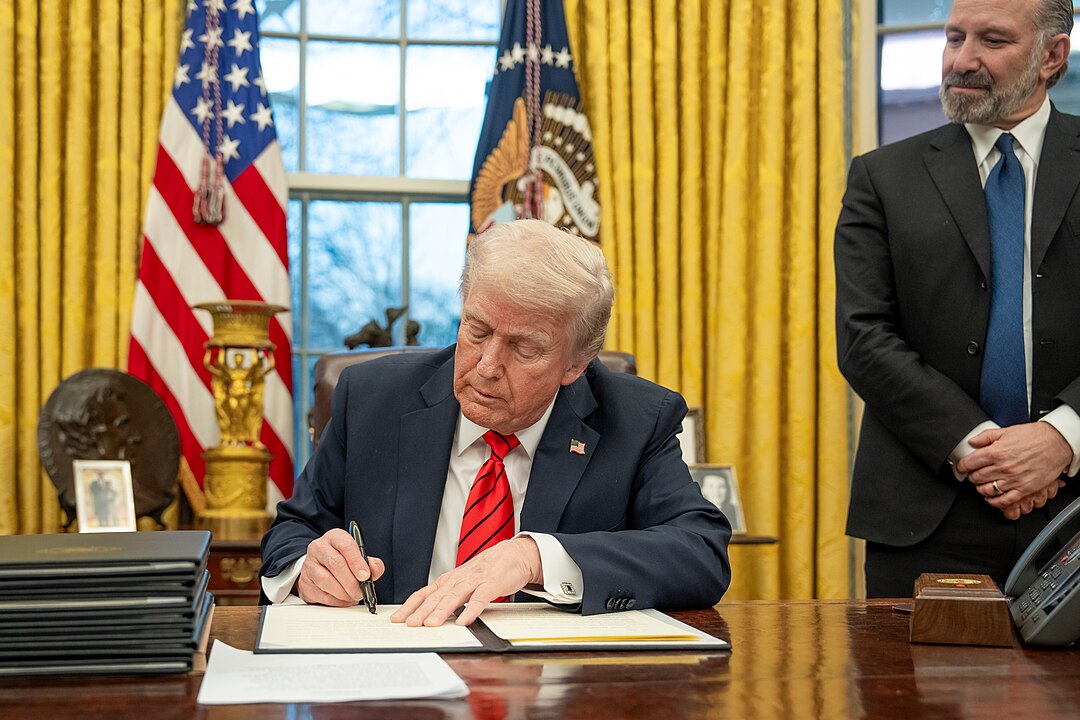
Trump was also scheduled to sign an executive order in the Oval Office Monday afternoon. The official White House schedule did not identify the subject of the order in advance. The president’s Monday agenda also included four closed-door policy meetings.
Sponsored
Stand with President Trump against fraud, waste & abuse – he can’t beat the machine without YOU.